In the age of GPS and digital maps, a reliable magnetic compass remains an indispensable tool for serious land navigation. It requires no batteries, is unaffected by signal loss, and provides a fundamental orientation that technology can supplement but never truly replace. Whether you’re a weekend hiker, a backcountry trekker, or a survival enthusiast, the right compass is your most trusted partner in the wilderness.
Choosing the best compass depends on your specific needs, from simple orienteering to advanced topographic map work. This roundup features ten top-tier options, from trusted Scandinavian brands to robust military-grade instruments. We’ve evaluated key features like global needle balancing, declination adjustment, sighting mirrors, and luminosity to help you find the perfect navigational aid for your adventures.
Our Selection of Top Land Navigation Compasses
- Explorer 2.0 Compass, Clear, One Size
- SUUNTO MCB: Simple sighting mirror compass that floats
- TurnOnSport Orienteering Compass for Hiking & Camping
- SUUNTO MC-2G Global Compass, White
- Silva Ranger 2.0 Advanced Compass with Mirror
- SUUNTO A-30 NH USGS Compass, Black
- Cammenga Official US Military Tritium Lensatic Compass
- SUUNTO KB-14 Compass: Hand-bearing compass
- Brunton Lensatic Military Style Sighting Compass
- Brunton TruArc 3 Baseplate Compass
Explorer 2.0 Compass

The Explorer 2.0 Compass is a well-rounded baseplate model designed for clarity and functionality. Its clear design and red/black north-south lines inside the capsule make it simple to read and allow for quick settling of the magnetic needle. This compass is built to handle various navigation tasks with ease.
A key benefit is its preparedness for low-light conditions. The luminous markings can be activated by daylight or a flashlight, providing up to four hours of visibility for nighttime navigation. Furthermore, the inclusion of a declination scale inside the capsule is a significant feature for those who need to account for the difference between magnetic and true north during map work.
SUUNTO MCB Compass

The SUUNTO MCB is a classic floating mirror compass that combines essential features with robust construction. Its ergonomic design includes a sighting mirror for taking precise bearings and for potential signaling in emergencies. As a compass that floats, it offers an added layer of security during water crossings or boating activities.
This model is balanced for the Northern Hemisphere and includes a fixed declination correction scale, a sighting hole, and notch for accuracy. The integrated snap-lock lanyard with a whistle is a thoughtful addition for safety. Made in Finland, the MCB is a dependable tool for hiking, trekking, and a wide range of outdoor sports.
TurnOnSport Orienteering Compass
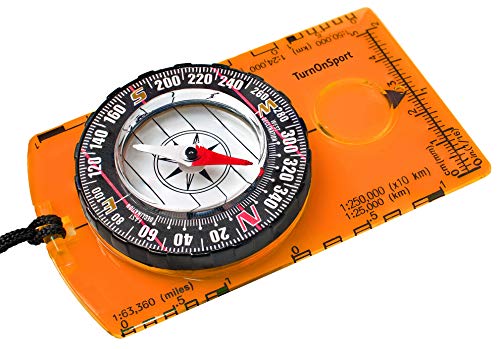
The TurnOnSport Orienteering Compass is a feature-packed baseplate compass suitable for both beginners and experienced users. It offers a complete navigation package with an acrylic baseplate, a 360-degree rotating bezel, and a fast-swinging liquid-filled capsule for stable readings. The integrated magnifying glass is particularly useful for reading fine map details.
This compass is designed for practical field use. It includes a ruler scale of 1:24000 for precise route mapping on standard topographic maps. Its portable and lightweight design makes it an essential piece of gear for scouts, hikers, and campers, providing professional navigation tools in an accessible format.
SUUNTO MC-2G Global Compass

The SUUNTO MC-2G is a professional-grade mirror compass built for global travel and serious navigation. Its key advantage is a needle balanced for use anywhere in the world, making it an ideal choice for international adventurers. The compass includes both Metric UTM scales and an inch ruler on the baseplate for versatile map work.
Precision is central to its design, featuring a sighting hole and notch for accurate bearing measurement, a built-in clinometer for slope angle, and a tool for adjusting declination. Operable in low-light conditions, the MC-2G is made for those who require dependable, advanced functionality in remote and challenging environments.
Silva Ranger 2.0 Advanced Compass

The Silva Ranger 2.0 is a sophisticated tool designed for the demanding navigator. It stands out with its integrated slope card, which allows for measuring terrain gradient and includes an extra distance lanyard for quick pace counting. The DryFlex rubber grip provides a secure, comfortable hold in all weather conditions.
This compass simplifies accurate navigation with a built-in adjuster for magnetic declination. This feature allows you to set the correction for your specific location once, enabling you to use true north readings directly from the compass without manual calculation during navigation.
SUUNTO A-30 NH USGS Compass

The SUUNTO A-30 is a compact and highly practical baseplate compass perfect for general hiking and orienteering. It features a high-grade steel needle with a jewel bearing for smooth operation and is balanced for the Northern Hemisphere. The transparent baseplate includes a magnifying lens for reading map details.
With luminescent markings for use in low light and Imperial measurement scales, it is a user-friendly and reliable choice. Its fixed declination and straightforward design make it an excellent tool for those who need a no-fuss, accurate compass for trail navigation and basic map work.
Cammenga Official US Military Tritium Lensatic Compass

The Cammenga Lensatic Compass is the official model used by the U.S. military, built to exacting standards for reliability and precision. Its robust olive drab construction is completely waterproof, shockproof, and sandproof, ready for the harshest conditions. The lensatic sighting system allows for highly accurate bearing readings.
Its most notable feature is the self-powered illumination. Using Tritium micro lights, the compass will glow reliably for over 12 years without batteries, sunlight, or any external power source. This makes it an unparalleled tool for guaranteed navigation in total darkness.
SUUNTO KB-14 Compass

The SUUNTO KB-14 is a professional hand-bearing compass engineered for high-precision directional measurements. It uses an optical reading system for exceptional accuracy, making it a favorite among surveyors, geologists, and other field professionals. The construction is focused on durability and stable operation.
Built with an anodized light-alloy housing and a sapphire bearing, it is made to withstand harsh environments. The liquid-filled capsule and jewel bearing ensure smooth and accurate readings across an extreme temperature range from -30°C to +60°C, providing consistent performance wherever your work takes you.
Brunton Lensatic Military Style Sighting Compass
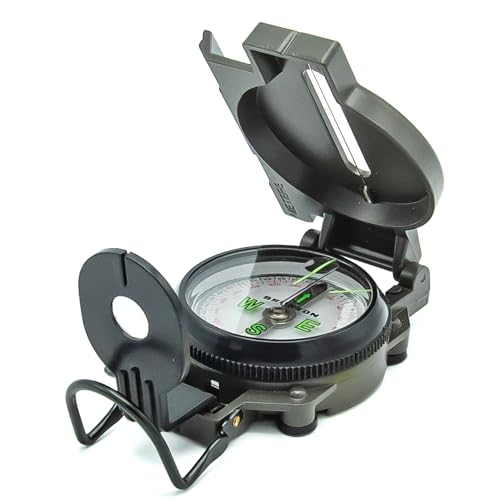
The Brunton Lensatic Compass offers a military-style sighting design known for its durability and straightforward functionality. This type of compass is recognized for its easy-to-use sighting mechanism, which allows you to align targets and take bearings with precision. It’s a robust tool built for outdoor use.
Ideal for camping and general land navigation, this compass provides a reliable method for finding your direction. Its construction focuses on the essential elements of a lensatic compass, delivering a trusted form factor that many outdoor enthusiasts prefer for its simplicity and effectiveness in the field.
Brunton TruArc 3 Baseplate Compass
The Brunton TruArc 3 is a modern baseplate compass designed for accurate and efficient navigation. While specific details for this model are not provided in our list, Brunton is a respected name in navigational tools, known for quality and innovation. Baseplate compasses like the TruArc 3 are typically excellent for map-oriented navigation.
These compasses generally feature a transparent base with measurement scales, a rotating azimuth bezel, and declination adjustment. They are a standard choice for orienteering, hiking, and educational purposes, providing a clear interface between the user, the map, and the terrain.
How to Choose a Compass for Land Navigation
Picking the right compass is more than just grabbing the first one you see. I’ve learned that the best compass for land navigation is the one that matches your specific activity and skill level. If you’re just starting out, you don’t need a complex military-grade unit, and if you’re a seasoned backpacker, a simple keychain compass won’t cut it. Let’s break down what I look for.
First, consider the baseplate compass. This is what most people picture. It has a clear, rectangular base with a rotating bezel (the ring with degrees) and a magnifying lens. I always check for a declination adjustment. This is a crucial feature that lets you correct for the difference between magnetic north and true north on your map. Without it, you’re adding a lot of mental math to your trip. The baseplate should have a ruler and map scales for plotting routes, and a luminous markings for low-light use is a huge plus.
For more precise travel over long distances, a lensatic or mirror compass is my go-to. These allow for sighting targets with much higher accuracy. The mirror lets you see the compass dial and a distant object simultaneously, ensuring you’re on the exact bearing. They’re often more durable but can have a steeper learning curve.
Durability is non-negotiable. I look for a solid, liquid-filled capsule that dampens the needle’s movement so it settles quickly. The housing should survive a drop onto rocks. For the needle itself, I prefer a global needle if I travel to different hemispheres, as a standard needle can dip or stick at high latitudes. Finally, think about extras: a lanyard to prevent loss, a clinometer for measuring slope angles, or a sighting notch for precise alignment. By matching these features to where and how you navigate, you’ll find a perfect partner for your adventures. Finding the right tool among the 10 best compasses for land navigation – Dec. 2025 starts with knowing these fundamentals.
FAQ
What’s the difference between a $10 compass and a $100 one?
The main differences are in precision, durability, and features. A cheaper compass might have a slower, less stable needle, a plastic baseplate that warps, and no declination adjustment. A higher-end model will have a fast, globally-balanced needle, a robust construction, a precise sighting mirror, and a reliable declination correction screw. For casual use, a basic one is okay, but for serious backcountry travel, the investment in reliability is worth it.
How do I account for magnetic declination?
Magnetic declination is the angle difference between true north (on your map) and magnetic north (where your needle points). You can find the current declination for your area on topographic maps or via online tools. If your compass has a declination adjustment (like a small screw), you can set it once and then forget it—your bearings will automatically be correct. If not, you must manually add or subtract the declination value every time you take or follow a bearing.
Can I rely solely on my phone’s compass app?
I would never recommend it as your primary tool. Phone compasses are magnetometers that can be easily thrown off by nearby metal (like your phone’s own components or a car), they drain battery, and they fail if your device gets wet, cold, or broken. A physical compass is a simple, reliable, and durable piece of safety gear that doesn’t need batteries. Use your phone as a convenient backup, not your main guide.
What does “global needle” mean and do I need one?
A standard compass needle is balanced for one hemisphere (usually the northern). If you take it to the opposite hemisphere, the needle can drag or stick on the capsule bottom, making it inaccurate. A global needle is balanced to work properly anywhere on Earth. If you only hike in, say, North America, you likely don’t need it. But if you travel internationally for trekking, it’s an essential feature to look for.
How do I properly take a bearing with a baseplate compass?
Place your compass on the map so the long edge connects your current position and your destination. Rotate the bezel until the orienting lines are parallel with the map’s north-south grid lines. The index line at the front will now show your true bearing. Now, hold the compass level in your hand, rotate your entire body until the magnetic needle is “boxed in” the orienting arrow (red-in-the-shed). The direction-of-travel arrow on the baseplate now points exactly where you need to go.