Choosing the right telescope can open up a universe of wonder for a young mind or a first-time stargazer. The best models for beginners balance simplicity with genuine capability, turning that first glimpse of the moon’s craters or Saturn’s rings into a lifelong passion. This guide highlights eight excellent options, from playful STEM toys for preschoolers to more powerful instruments ready to reveal the cosmos.
We’ve selected products that prioritize ease of use, durability, and educational value. Whether you’re looking for a toy to spark initial curiosity or a real telescope that grows with a child’s interest, you’ll find a great match on this list. Each entry is designed to provide a rewarding experience without the frustration that can sometimes come with complex equipment.
Our Recommended Telescopes for New Stargazers
- GeoSafari Jr. Talking Telescope STEM Toy
- Educational Insights GeoSafari Omega Refractor Telescope
- Little Experimenter Projector Telescope for Kids
- Telescope for Kids & Adults – 70mm Aperture 500mm
- Celestron Travel Scope 70 Portable Refractor Telescope
- AOMEKIE Telescopes,70mm Aperture 300mm Table Tripod
- Gskyer Telescope, 70mm Aperture 400mm AZ Mount
- Celestron – PowerSeeker 127EQ Telescope
GeoSafari Jr. Talking Telescope STEM Toy

This interactive toy is the perfect introduction to space for preschoolers. It removes the technical challenges of a real telescope, allowing very young children to view stunning, built-in images from NASA with both eyes open. The engaging audio feature shares fun facts and quiz questions about our solar system, making learning a hands-on, auditory experience.
It is designed specifically for small hands and growing minds, focusing on sparking curiosity rather than technical operation. The GeoSafari Jr. Talking Telescope builds foundational knowledge about planets, stars, and space exploration through play. It’s an excellent first step before moving on to optical telescopes.
Educational Insights GeoSafari Omega Refractor Telescope
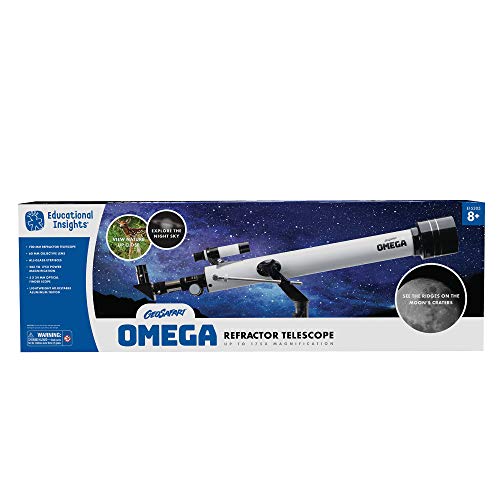
This refractor telescope is a serious tool suitable for beginners aged 8 to adult. Its 700mm focal length and 60mm objective lens provide excellent magnification, from 28x to 175x, with the ability to reach higher powers using the included Barlow lens. The all-glass optics ensure clear, bright views of the moon and planets.
It comes with multiple eyepieces and a sturdy, deluxe telescoping tripod for stable viewing. The GeoSafari Omega is built for those ready to move beyond a simple toy and engage in real sky observation. Its quality construction makes it a reliable choice for family stargazing sessions.
Little Experimenter Projector Telescope for Kids
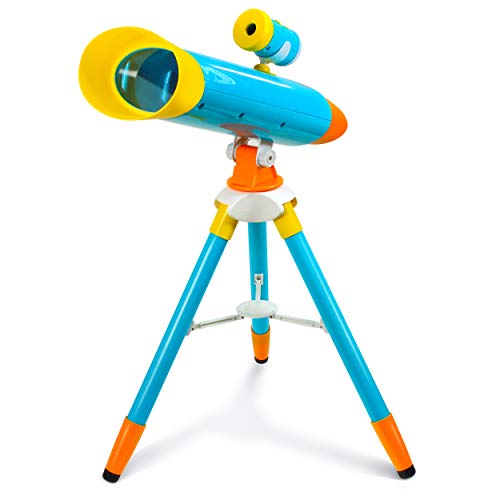
This versatile tool functions as both a 2x magnification telescope and a celestial projector. Children can use it to look at the night sky and then project 24 different space images onto their wall for a immersive bedroom planetarium experience. The swivel design and foldable tripod allow for easy adjustment.
Built with durability in mind, it features a soft, flexible eyepiece that comfortably fits around both eyes, eliminating the common beginner’s struggle of closing one eye. This combination of practical viewing and imaginative play makes astronomy accessible and fun for children as young as three.
Telescope for Kids & Adults – 70mm Aperture 500mm
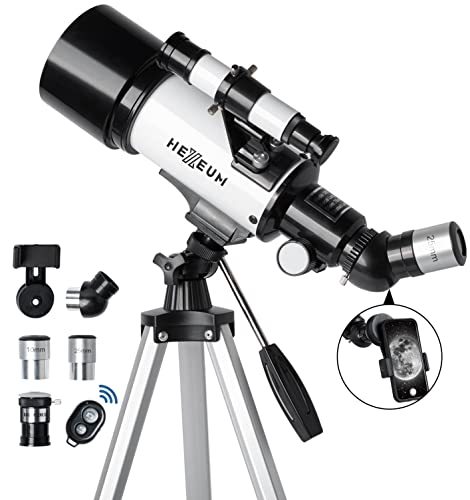
This 70mm aperture refractor offers a significant upgrade in light-gathering ability, providing brighter and more detailed views of celestial objects. The fully multi-coated optics protect your eyes and enhance image clarity. With a 500mm focal length and a set of eyepieces plus a 3x Barlow lens, it offers a wide range of magnification options.
It is designed for user convenience, featuring an adjustable aluminum tripod, a carrying bag, and a phone adapter for astrophotography. The inclusion of a wireless remote control is a thoughtful touch for capturing steady images. This telescope is a complete kit that can serve the whole family.
Celestron Travel Scope 70 Portable Refractor Telescope

The Celestron Travel Scope 70 is renowned for its portability and ease of use. Its fully-coated 70mm glass optics deliver sharp views of the moon and planets, while the lightweight design and included custom backpack make it ideal for trips to darker skies. Setup requires no tools and can be completed in minutes.
This telescope is a favorite among beginners because it minimizes frustration and maximizes observing time. The package includes helpful astronomy software to help you navigate the night sky. It’s a practical, high-value option for anyone who wants a quality telescope that’s ready to go anywhere.
AOMEKIE Telescopes,70mm Aperture 300mm Table Tripod

This compact refractor telescope is designed for tabletop use, making it very stable and simple to operate for beginners. The 70mm aperture and fully multi-coated optics gather ample light for clear viewing. It offers up to 150x magnification with the included eyepieces and Barlow lens.
The kit is notable for its useful accessories, including a moon filter to reduce glare, a 90-degree diagonal for comfortable viewing, and a smartphone adapter. The 5×24 finderscope assists in locating targets. It’s a comprehensive set that provides great functionality in a smaller, user-friendly format.
Gskyer Telescope, 70mm Aperture 400mm AZ Mount
The Gskyer 70mm model is a popular and reliable entry-level astronomical telescope. Its 400mm focal length provides a good balance between magnification and a wide field of view, making it easier to locate objects. The altazimuth (AZ) mount is intuitive for beginners to point and track.
This telescope typically comes with multiple eyepieces and accessories like a finderscope and tripod. The 70mm aperture ensures bright images of the moon, star clusters, and brighter planets. It represents a solid step into real astronomy without a complex setup.
Celestron – PowerSeeker 127EQ Telescope
The PowerSeeker 127EQ is a reflector telescope that offers a large 127mm aperture for its price point, allowing for impressive views of planets and deep-sky objects like nebulae. The equatorial mount helps track objects smoothly as the Earth rotates, which is a valuable feature for serious beginners to learn.
While it has a steeper learning curve than altazimuth mounts, the equatorial system provides a more authentic astronomical experience. This telescope is for the beginner who is committed to learning the hobby and wants a powerful optical system that will continue to be useful as their skills advance.
Buying Guide: What to Look For in the 8 Best Telescopes for Kids and Beginners
Choosing your first telescope is exciting, but the options can be overwhelming. I remember my first scope; I made a few classic mistakes. The goal is to find an instrument that’s easy to use, durable, and actually shows you cool stuff without breaking the bank. Here’s what I’ve learned to focus on.
First, let’s talk about the most important part: the aperture. This is the diameter of the main lens or mirror, and it’s the telescope’s light-gathering engine. A bigger aperture means brighter, clearer images. For a beginner, I recommend starting with at least 70mm for a refractor or 114mm for a reflector. This gives you enough power to see the Moon’s craters in stunning detail, Saturn’s rings, and Jupiter’s moons. Don’t get fooled by high magnification claims; a big aperture on a steady mount is far more valuable.
Speaking of mounts, this is where many cheap telescopes fail. A wobbly mount turns stargazing into a frustrating game of chase-the-star. Look for a solid, slow-motion alt-azimuth mount (it moves up-down and left-right) for simplicity. Equatorial mounts are great for tracking objects but have a steeper learning curve. For kids, simplicity wins every time. The mount should feel stable, with smooth controls.
Portability and setup are huge factors. If it takes 45 minutes to assemble and is too heavy to move, it will gather dust in a closet. A good beginner scope should be something you can carry outside in one or two trips and have ready in under 10 minutes. Also, consider the finderscope—a little pointer that helps you aim. A red dot finder is much easier for beginners than a tiny optical finderscope.
Finally, manage your expectations. You won’t see Hubble-like color images. You’ll see planets as small, bright discs and galaxies as faint grey smudges. The magic is in knowing what you’re looking at. A scope that comes with good astronomy software or a planisphere is a big plus. Remember, the best telescope for you is the one you’ll use often. Start simple, learn the sky, and you’ll be hooked. This mindset is key when looking at any list of the 8 best telescopes for kids and beginners.
Frequently Asked Questions
What can I realistically see with a beginner telescope?
You can see a lot! The Moon will be your first and most impressive target, with its craters and mountains looking like you’re in orbit. You’ll be able to see the phases of Venus, the polar ice caps on Mars (when it’s close), Jupiter and its four largest moons, and Saturn’s rings. Beyond our solar system, you can find bright star clusters like the Pleiades and the Hercules Cluster, and some of the brighter nebulae like the Orion Nebula. Galaxies will appear as faint, fuzzy patches. The views are subtle but profoundly exciting when you understand what they are.
Is a reflector or refractor telescope better for a beginner?
Both have pros and cons. Refractor telescopes (with a lens at the front) are generally more low-maintenance, sealed against dust, and good for lunar, planetary, and terrestrial viewing. They can be more expensive per inch of aperture. Reflector telescopes (with a mirror at the back) offer more aperture for your money, making them great for viewing fainter deep-sky objects. They occasionally need optical alignment (collimation). For a very young child, a simple, small refractor is often the most durable choice. For an older kid or adult beginner wanting more power, a reflector is a fantastic value.
Why is the mount so important?
Think of the mount as the telescope’s foundation. A good optical tube on a poor mount is almost unusable. A shaky mount magnifies every tiny vibration, making the image jiggle wildly every time you touch the scope or even when the wind blows. This makes focusing impossible and frustrates new users quickly. A solid, smooth-moving mount is arguably more important than the telescope tube itself for a positive first experience. Always check reviews about the mount’s stability.
Can I use a telescope to look at things during the day?
Yes, but you must be extremely cautious. Never, ever point a telescope at or near the Sun without a proper solar filter designed for the front of the telescope. Doing so will instantly cause permanent eye damage. With that major warning, many refractor telescopes can be used for terrestrial viewing—like birds or landscapes—by using an erecting prism (which often comes with the scope). This makes the image right-side-up. Reflectors are not ideal for this.
My child is interested. Should I buy a high-magnification telescope?
Resist the hype around magnification. High power (like 600x) sounds impressive, but it’s almost always useless. It magnifies the blur from Earth’s atmosphere, heat waves, and any shake in the mount, resulting in a dim, fuzzy image. Most quality observing is done between 50x and 150x. A good beginner scope will come with maybe two or three eyepieces (e.g., 25mm for low power, 10mm for medium power). The quality of the optics and the steadiness of the mount are far more important than the highest magnification number on the box.
How do I find objects in the sky?
Start with the brightest, easiest targets: the Moon and planets. Use a free astronomy app on your phone or tablet to point you in the right direction. These apps use your phone’s GPS and gyroscope to show you a live map of the sky above you. They make finding constellations and brighter deep-sky objects much easier. Pair that with your telescope’s finderscope (align it during the day on a distant object), and you’ll be navigating the night sky in no time. Patience and practice are your best tools here, which is why a simple, user-friendly model from a list of the 8 best telescopes for kids and beginners is the perfect starting point.