Flying a kite in strong winds is a thrilling experience, but it demands a kite built to handle the challenge. A high-wind kite needs a robust frame, durable sail material, and a design that provides stability without being torn from your hands. This roundup focuses on kites engineered for performance when the breeze really picks up, from majestic single-line showpieces to agile dual-line stunt models.
Whether you’re looking for a dramatic dragon to rule the sky or a responsive sport kite for acrobatics, the right equipment makes all the difference. We’ve selected eight excellent kites known for their resilience and flight characteristics in stronger conditions. The following options combine quality construction with designs that thrive where others might struggle.
Our Top Picks for High-Wind Kites
- WindNSun Super Size 3D Nylon Kite, Blue Dragon
- Prism Kite Technology Quantum 2.0 Graphite Dual-line Stunt Kite
- Premier Kites Paradise Bird Kite with 70 Inch Wingspan
- Prism Kite Technology Nexus 2.0 Spectrum Dual-line Stunt Kite
- 2.5m Dual Line Stunt Parafoil Kites Soft Stunt Kite
- HQ Kites Pocket Sled Single Line Kite – Jolly Roger
- Into the Wind Synapse 200 Dual Line Parafoil Kite
- Premier Kites Wolf NG Dual Line Stunt Kite
WindNSun Super Size 3D Nylon Kite, Blue Dragon

This impressive 76-inch wide dragon kite is built for presence and performance. Its three-dimensional design creates a striking silhouette in the sky, while the combination of a fiberglass frame and ripstop nylon sail provides the durability needed for consistent flights. The materials are selected to stand up to the stresses of high-wind conditions.
Assembly is straightforward, and the kite comes in a ready-to-fly configuration. The engineering focuses on stable flight, ensuring the dragon remains controllable even as the wind speed increases. It’s a fantastic choice for anyone wanting a large, visually spectacular kite that can handle a robust breeze.
Prism Kite Technology Quantum 2.0 Graphite Dual-line Stunt Kite

The Quantum 2.0 is a full-sized dual-line stunt kite designed for precision and power. Its 7-foot wingspan offers inherent stability, making it easier to control as you perform maneuvers. The kite is responsive in lighter winds but truly shows its capability with impressive pull and solid tracking when the breeze strengthens.
Advanced features like the spine shock absorber system help protect the airframe during hard landings, a valuable trait for high-wind flying. The updated 2.0 version includes an improved wing shape and a one-step bridle adjustment, allowing pilots to fine-tune the kite’s performance quickly for changing conditions.
Premier Kites Paradise Bird Kite with 70 Inch Wingspan

With a large 70-inch wingspan, this bird kite is designed to catch the eye and the wind. It is constructed with a fiberglass frame and polyester ripstop fabric, a combination that reinforces the kite for durability. This build quality helps it manage higher wind speeds effectively.
The kite is noted for being easy to fly and includes everything needed to start: 300 feet of line, a hand grip spool, and a storage sleeve. Its size and reinforced technology allow it to soar with ease, providing a reliable and visually appealing flight experience even on windier days.
Prism Kite Technology Nexus 2.0 Spectrum Dual-line Stunt Kite
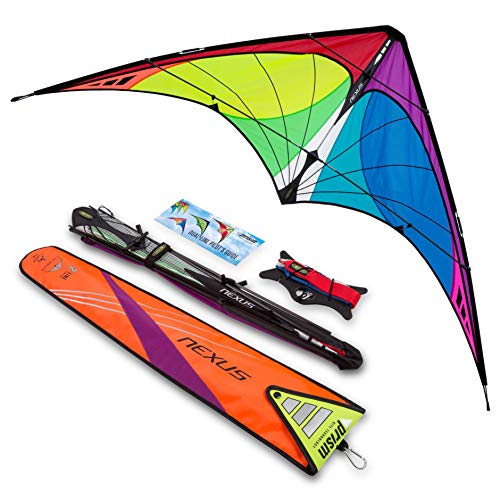
The Nexus 2.0 Spectrum is a versatile and portable dual-line kite that doesn’t compromise on performance. Its rugged carbon fiber frame offers a great balance of strength and lightness, capable of handling the forces encountered in stronger winds. The durable sail material complements this robust frame.
Praised as an excellent all-around kite, it is compact enough for travel but delivers real performance for learning tricks and basic acrobatics. The balanced design provides stability, which is a key asset when flying in variable or high-wind conditions, giving pilots confidence as they build their skills.
2.5m Dual Line Stunt Parafoil Kites Soft Stunt Kite

This 2.5-meter parafoil kite is a soft kite with no rigid spars, making it resilient in challenging conditions. It is specifically noted as suitable for flying in level 3 winds, indicating its design for steady performance in a decent breeze. The parafoil design provides inherent stability and pull.
It is easy to fly, carry, and set up, serving as a great trainer kite that can also provide substantial power. The lack of a breakable frame makes it a practical choice for high-wind environments where hard landings might occur, as it can simply collapse without damage.
HQ Kites Pocket Sled Single Line Kite – Jolly Roger

The Pocket Sled is a compact, ready-to-fly kite that excels in simplicity and portability. Its sled design is naturally stable and performs well in a range of winds, including stronger gusts. The included 18-pound test line is strong enough to handle the tension from high-wind flight.
Everything stores neatly in its own mini zipper backpack with a keyring, making it incredibly easy to take anywhere. Despite its small 13″ x 17″ size, this durable kite offers surprising performance and is a reliable, low-fuss option for windy days at the beach or park.
Into the Wind Synapse 200 Dual Line Parafoil Kite
The Synapse 200 is a dual-line parafoil kite built for responsive control and trick capability. As a parafoil, it has no rigid spars, which makes it highly durable and resistant to damage from crashes or strong wind gusts. This construction allows it to generate significant power and speed.
It is designed for pilots looking to progress from basic flying to precise maneuvers. The kite’s stability and feedback in the lines make it suitable for windier conditions where control is paramount. It’s a serious sport kite that packs down small for easy transport.
Premier Kites Wolf NG Dual Line Stunt Kite
The Wolf NG is a dual-line stunt kite known for its smooth flight and durability. It features a design that balances speed with stability, allowing for controlled flight and trick execution when the wind is up. The frame and sail are built to withstand the demands of frequent, energetic flying.
This kite is suitable for intermediate fliers looking to hone their skills in various wind conditions. Its predictable handling and robust construction provide the confidence needed to fly in stronger breezes, making it a reliable choice for consistent high-wind performance.
Buying Guide: How to Choose the Best Dragon Kite for High Winds
So you want a dragon kite that can handle a serious breeze? I get it. There’s nothing like the sight of a massive, detailed dragon holding strong against a powerful wind. But not every dragon kite is built for those conditions. Picking the wrong one can lead to a quick crash or, worse, a shredded kite. Let me walk you through what I look for when I’m hunting for the best dragon kite for high winds.
First, let’s talk materials. This is non-negotiable. For high winds, you need a kite made from strong, ripstop nylon or polyester. These fabrics are woven to resist tearing, and they’re what will keep your dragon in the air when the wind picks up. Avoid cheap, thin plastics or non-ripstop fabrics; they simply won’t last. The frame is equally important. Look for flexible fiberglass rods. They provide the structure but have enough give to absorb gusts without snapping. Solid, reinforced stitching at the stress points (like where the spars connect to the sail) is another sign of a well-made kite.
Next, consider the design and stability. A good high-wind dragon kite needs a reliable bridle system—that’s the set of strings connecting the kite to your flying line. An adjustable bridle is a huge plus, as it lets you fine-tune the kite’s angle to the wind for different conditions. I also pay close attention to the tail. For dragon kites, the tail isn’t just for show; it’s a crucial stability device. In high winds, a long, flowing tail helps prevent the kite from spinning or looping uncontrollably. Some of the best designs have segmented tails that add drag and balance perfectly.
Finally, think about size and setup. A larger kite will catch more wind and generate more pull, which can be exhilarating but also requires more strength and a stronger line. Make sure you’re ready for that. I always recommend using a Dacron or Dyneema flying line for high-wind flying, as they have high tensile strength and low stretch. Also, check how the kite assembles. A simple, intuitive design with color-coded or clearly marked connectors makes setup at the windy field much less of a hassle. By focusing on these key areas—durable materials, a stable design, and appropriate size—you’ll find a dragon that’s built to soar when others are grounded.
Frequently Asked Questions
What makes a dragon kite suitable for high winds?
A high-wind dragon kite is specifically engineered with durability and stability in mind. It uses strong ripstop fabric to resist tearing under pressure and flexible fiberglass spars that can bend with gusts instead of breaking. The design often includes a well-tuned, adjustable bridle and a long, stabilizing tail to keep it flying smoothly without excessive spinning or dive-bombing. It’s the combination of these rugged materials and smart aerodynamic features that creates a kite capable of handling the challenge.
Can I fly a high-wind dragon kite in light breeze?
You can, but it might not perform ideally. Kites designed for strong winds often need a certain amount of force to fully inflate and take shape. In very light winds, a heavy-duty kite may feel sluggish, not fully open, or struggle to gain altitude. For variable conditions, look for a model with an adjustable bridle; this allows you to change the kite’s angle to better catch lighter breezes. However, if you mostly have gentle winds, a lighter, single-line kite might be more fun.
How do I launch and fly a large dragon kite in strong wind?
Safety and control are key. I always wear gloves to protect my hands from line burns. Have a friend act as your launcher, holding the kite downwind while you unwind about 50 feet of line. On your signal, your helper releases the kite as you gently pull in line to help it climb. Never run to launch—let the wind do the work. Once airborne, let out line steadily. If the pull becomes extreme, don’t hesitate to walk downwind to reduce pressure or smoothly reel in some line. Always use a strong, reliable kite line rated for the expected pull.
What is the best line to use for high-wind kite flying?
Do not use ordinary string! It’s dangerous and will break. For high-wind flying, I use either Dacron (polyester) or Spectra/Dyneema lines. Dacron is strong, has some stretch for shock absorption, and is very affordable. Spectra/Dyneema is stronger for its diameter, has almost no stretch, and is very smooth, but it can be more expensive. Choose a line with a minimum breaking strength of at least 200-300 pounds for larger dragon kites, and always wind it onto a proper kite reel or winder for control.
Are these kites safe to fly near people or power lines?
Absolutely not. A large dragon kite in high winds generates significant pull and can be unpredictable. Always fly in a wide-open area like a beach, large park, or empty field. Maintain a clear distance of at least 500 feet from all power lines—this is extremely dangerous and can be fatal. Keep a safe perimeter from people, roads, and trees. Your flying site should be free of obstacles both on the ground and overhead. Being the pilot means being responsible for everyone’s safety.
How do I store and care for my dragon kite?
Proper care makes it last for years. After flying, I always make sure the kite is completely dry before packing it away to prevent mildew. Gently disassemble the spars and fold the sail along its natural seams, avoiding sharp creases. Store it in a cool, dry place, not in a hot car or damp garage. Periodically check the fabric for small tears (which can be repaired with ripstop tape) and inspect the spars for cracks. Taking these few minutes to care for your gear ensures your best dragon kite for high winds is ready for the next adventure.