For birders, a quality spotting scope is more than just a tool; it’s a passport to a hidden world of detail and color. It transforms a distant silhouette into a clearly identifiable species, revealing intricate feather patterns and subtle behaviors that binoculars alone can miss. Whether you’re scanning a marsh for waterfowl or tracking a warbler in the canopy, the right scope brings the action closer.
Choosing the best spotting scope for birding depends on your needs and budget. Options range from excellent value beginner kits to professional-grade optical instruments. This roundup covers a spectrum of models, each with strengths in magnification, light gathering, durability, and portability, to help you find your perfect match for the field.
Our Top Picks for Birding Spotting Scopes
- SVBONY SV28 Spotting Scopes with Tripod
- Celestron 52250 Ultima 20-60x80mm Angled Refractor
- Emarth 20-60×60 Angled Spotting Scope w/Tripod
- GOSKY 20-60 X 80 Porro Prism Spotting Scope
- CREATIVE XP 20×60 80mm ED Spotter Scope
- Swarovski Optik ATS-65 HD Spotting Scope
- Leica APO-Televid 82 Angled Spotting Scope
- Ares G2 UHD 15-45×65 Spotting Scopes (Straight)
- Celestron Ultima 80 Angled Spotting Scope
SVBONY SV28 Spotting Scopes with Tripod
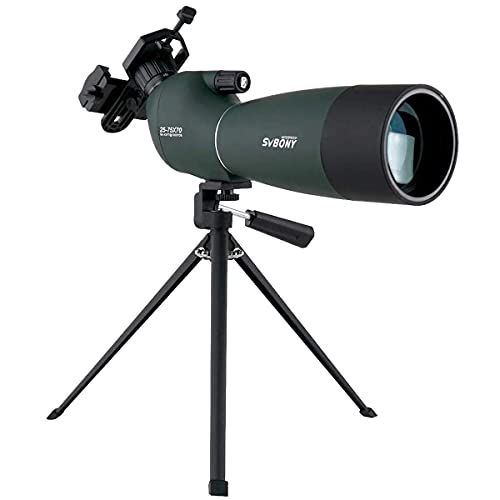
This SVBONY kit is a fantastic starting point for new birders. The 25-75x zoom range on the 70mm objective lens provides flexible magnification to suit different viewing situations, from wide-field scanning to closer inspection. Its straightforward design makes it easy to focus and set up quickly when you spot a bird.
The scope is built to handle outdoor use with a waterproof design and a non-slip rubber armor grip. The included tripod and phone adapter mean you have everything needed to begin stable observation and even try your hand at digiscoping right out of the box. The extendable sunshade helps manage glare for a clearer view.
Celestron 52250 Ultima 20-60x80mm Angled Refractor

A long-standing favorite, the Celestron Ultima 80 offers a great balance of performance and value. The large 80mm objective lens gathers ample light for bright images, which is particularly useful during dawn or dusk birding sessions. The 45-degree angled eyepiece is comfortable for prolonged viewing, especially when observing birds at higher elevations.
Multi-coated optics enhance image brightness and color fidelity. This scope is sold as a comprehensive package, including a soft case, tripod mounting plate, and a T-adapter for attaching a camera, making it a versatile choice for various outdoor activities beyond birding.
Emarth 20-60×60 Angled Spotting Scope w/Tripod
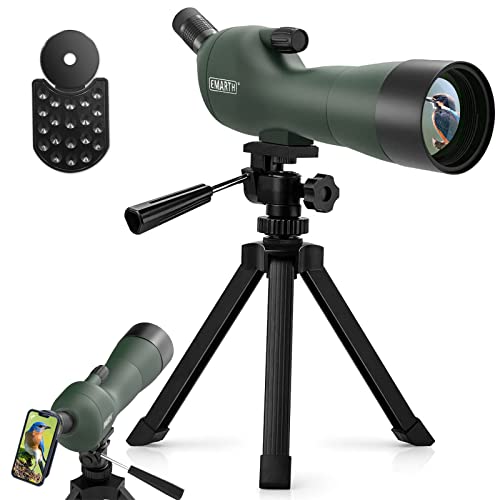
Portability is the key advantage of the Emarth spotting scope. Weighing just over 1.3 pounds, it is exceptionally easy to pack for long hikes or travel. Despite its light weight, it doesn’t compromise on core features, offering a 20-60x zoom and a 60mm objective lens with BAK4 prisms for a clear image.
The included 14-inch tabletop tripod provides a stable base when you need it, and the whole kit fits neatly into the supplied carrying bag. This setup is ideal for birders who prioritize minimizing the weight of their gear without sacrificing the ability to zoom in on distant subjects.
GOSKY 20-60 X 80 Porro Prism Spotting Scope

The GOSKY scope is built for durability and reliable performance in the field. Its magnalium framework and shock-absorbing rubber armor offer solid protection against bumps and the elements. The fully multi-coated 80mm lens system is designed to deliver bright, crisp views across its magnification range.
This model is a straightforward, robust instrument focused on providing good optical quality in a tough package. The dynamic focusing system allows for smooth adjustment to get your subject sharp, which is essential when trying to identify fine details on a bird in changing light conditions.
CREATIVE XP 20×60 80mm ED Spotter Scope

This CREATIVE XP scope addresses a common optical issue by incorporating Extra-low Dispersion (ED) glass. The ED glass significantly reduces chromatic aberration (color fringing), resulting in a cleaner, sharper image with better color accuracy, especially at higher magnifications. This makes distinguishing subtle markings on birds much easier.
It is also built as a complete system for the modern birder. With an IP67 waterproof rating, a photo clicker, and a phone adapter included alongside the tripod, it is ready for both serious observation and capturing digital memories of your sightings in challenging weather.
Swarovski Optik ATS-65 HD Spotting Scope

The Swarovski ATS-65 HD represents the high end of birding optics. Its fluoride-containing HD lenses are engineered to produce images with exceptional contrast and minimal color distortion. The result is a viewing experience marked by stunning clarity and true-to-life color that can reveal details other scopes might miss.
While the 65mm objective lens is moderately sized, the superior optical design ensures bright, high-resolution images. The angled body style is preferred by many birders for its ergonomic comfort during long sessions of sky or tree-canopy watching.
Leica APO-Televid 82 Angled Spotting Scope

The Leica APO-Televid 82 is a top-tier professional spotting scope. Its apochromatic (APO) optical system and large 82mm front lens work together to deliver exceptionally bright, high-contrast views with brilliant color fidelity and edge-to-edge sharpness. The dual focusing mechanism allows for both fast rough focusing and precise fine-tuning.
Constructed with a magnesium housing and rubber armoring, it is both lightweight for its class and built to withstand rigorous field use. This scope is designed for the serious birder or naturalist who demands the absolute best in optical performance and mechanical precision.
Ares G2 UHD 15-45×65 Spotting Scopes (Straight)
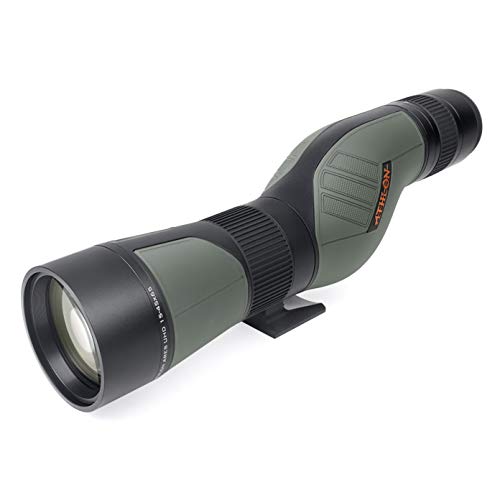
The Ares G2 UHD scope utilizes advanced optical technology typically found in higher-priced models. Its apochromatic lens system and Extra-Low Dispersion glass aim to maximize image sharpness and color definition while eliminating chromatic fringing. The ESP Dielectric coating is designed to reflect maximum light to your eye for a bright view.
With argon purging for reliable waterproof and fogproof performance, it is built to handle extreme environmental conditions. The straight-body design can be preferable for users who frequently switch between scanning with binoculars and using the scope.
Celestron Ultima 80 Angled Spotting Scope
This Celestron Ultima 80 model offers the trusted performance of the Ultima series in a popular angled configuration. The 80mm objective lens provides excellent light-gathering capability for clear viewing in various lighting conditions, which is crucial for early morning or late afternoon birding when activity is high.
Its multi-coated optics help ensure bright, high-contrast images. As a well-established model from a reputable brand, it represents a solid mid-range choice for birders looking for reliable performance without stepping into the premium price category.
How to Choose the Best Spotting Scopes for Birding
When I’m looking for the best spotting scopes for birding, I think about it as a long-term investment in my hobby. The wrong choice can mean missed sightings and frustration, while the right one becomes an extension of your own eyes. The first and biggest decision is between an angled or a straight eyepiece body. Angled scopes are my personal favorite for birding. They’re much easier to share with people of different heights, and they’re more comfortable for looking at birds in trees or in the sky without craning your neck. Straight scopes are often preferred for digiscoping (attaching a camera) and can feel more intuitive for scanning across a flat landscape like a marsh.
Next, I always check the objective lens size and magnification. For birding, an 80mm objective lens is the sweet spot for most people. It gathers plenty of light for clear, bright images in dawn or dusk conditions, which is when a lot of birds are active. You can find smaller 60mm models that are lighter, but they sacrifice some brightness. Magnification comes from the eyepiece. A zoom eyepiece, like a 20-60x, is incredibly versatile. I use low power to find the bird and then zoom in for detail. Just remember, at the highest magnifications, image shake and atmospheric haze become more noticeable, so a good, solid tripod is non-negotiable.
Optical quality is everything. The glass and coatings are what you’re really paying for. Look for terms like ED (Extra-low Dispersion), HD (High-Density), or Fluorite glass. These elements reduce chromatic aberration—that annoying color fringing you see on high-contrast edges—resulting in a sharper, truer-to-life image. Fully multi-coated lenses ensure maximum light transmission. Finally, don’t forget about the practical stuff. The scope should be waterproof and fog-proof (nitrogen or argon purged). A smooth, precise focus knob is critical for nailing that sharp look at a warbler flitting in the bushes. Weight and size matter if you hike to your spots, and a durable, rubber-armored body can survive the inevitable bumps.
Frequently Asked Questions
Is a spotting scope really necessary for birding, or are binoculars enough?
For general birding, binoculars are your essential, go-to tool. They’re lightweight, easy to carry, and perfect for identifying birds at short to medium distances. I think of a spotting scope as a powerful supplement. It’s for those times when you need a detailed, magnified look at a distant bird on a lake, a shorebird on a mudflat, or a raptor on a cliff face. It brings far-away subjects close for identification of fine details like leg color or bill shape that binoculars can’t resolve.
What’s a good magnification range for a birding spotting scope?
Most birding scopes come with a zoom eyepiece, and a 20-60x magnification is the most common and practical choice. I start at 20x or 25x to get a wide field of view and locate the bird easily. Once I have it in sight, I zoom in to 40x, 50x, or even 60x to see the finer markings. Be aware that on days with heat haze or turbulence, the view at 60x can be soft and wavy; dialing back to 40x often gives a clearer picture. Fixed-power eyepieces (like a wide-angle 30x) offer a brighter, wider view but lack flexibility.
How important is the tripod for a spotting scope?
It is absolutely critical. A cheap, wobbly tripod will make even the most expensive scope useless at higher magnifications. Every tiny shake is amplified. I recommend investing in a sturdy, quality tripod that is rated to hold more than the weight of your scope. Look for one with a fluid or smooth panning video head for effortless tracking of moving birds. A good tripod-and-head combo improves your viewing experience more than you might think and is a key part of any setup.
Can I use my spotting scope for other activities besides birding?
Absolutely! A quality spotting scope is incredibly versatile. I’ve used mine for wildlife observation, at outdoor sporting events, and for general scenic viewing. They are fantastic for astronomy, offering stunning views of the moon and larger star clusters. Many people also use them for digiscoping—attaching a smartphone or camera to the eyepiece to take photos and videos. If you enjoy any activity that requires seeing distant detail, a spotting scope is a great tool.
What does “close focus” mean, and why does it matter for birding?
Close focus is the minimum distance at which the scope can focus on a subject and still produce a sharp image. For birding, a shorter close-focus distance is a nice bonus. It means you can use your scope on surprisingly close subjects, like a butterfly on a nearby flower or a sparrow hopping in a bush just meters away. While not its primary job, this flexibility turns your scope into a powerful macro-like viewer, adding to its usefulness in the field.