Moving heavy loads safely and efficiently requires the right tool for the job. A reliable hand winch is indispensable for boat owners, farmers, contractors, and outdoor enthusiasts who need to pull, lift, or secure substantial weight. From loading a boat onto a trailer to recovering an ATV or hoisting equipment on a job site, a quality winch provides the mechanical advantage and control you need.
This roundup examines nine of the best hand winches for heavy loads, covering a wide range of capacities and designs. Whether you need a simple manual crank for your trailer or a powerful lever hoist for industrial tasks, you’ll find a capable option here. We’ve highlighted key features, construction quality, and ideal use cases to help you select the perfect winch for your demanding projects.
Our Top Picks for Heavy-Duty Hand Winches
- Camco 2000lb Boat Trailer Winch with Strap
- TR Industrial 600 lb. Trailer Winch
- TYT 1200LB Boat Trailer Winch with Steel Cable
- Trailer Winch – Durable Hand Crank – 3500 lbs
- Reese Towpower 74329 Trailer Hand Crank Winch
- Superwinch 1120210 LT2000 12-Volt ATV Winch
- Jack Boss Hand Winch, 600 lbs Pulling Capacity
- Maasdam 48610 Lever Hoist 1-1/2 Ton
- Clevr 4 Ton Heavy Duty Hand Winch with 20ft Cable
Camco 2000lb Boat Trailer Winch with Strap
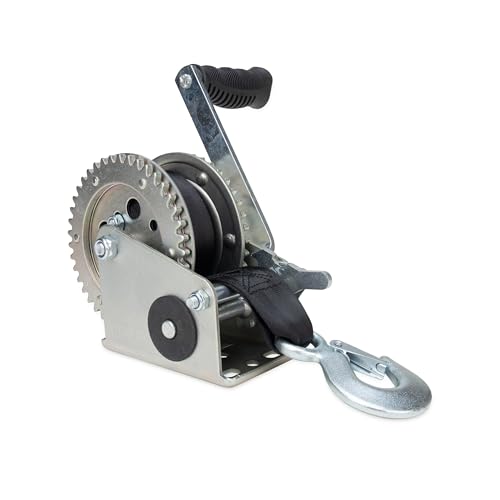
Designed specifically for marine use, the Camco 2000lb winch is a top choice for boat owners. It comes ready with a 20-foot strap, making boat loading onto a tow trailer a smooth and controlled process. The two-way ratchet mechanism provides secure forward and reverse operation, with a neutral position for free spoiling when needed.
A comfort-grip handle reduces hand fatigue during extended cranking sessions. With a solid 2,000-pound weight capacity, this winch handles many small to medium-sized boats with reliability. Its straightforward design focuses on the essential features required for safe and accurate trailer loading.
TR Industrial 600 lb. Trailer Winch

Built with an all-steel frame and gears, the TR Industrial winch is made for longevity. Its premium steel construction and high-quality zinc and black plating offer strong protection against wear, tear, and weather elements. This makes it a durable option for those who need a winch that can withstand outdoor storage and use.
With a 600-pound capacity, it is well-suited for lighter trailers, utility tasks, or as a secondary winch. The versatile drum design is a key benefit, as it accepts straps, steel cables, or ropes. Installation is simple, requiring only mounting and attaching your chosen line and handle.
TYT 1200LB Boat Trailer Winch with Steel Cable

The TYT winch offers a balanced package with a 1200-pound capacity and a generous 26-foot steel cable included. Its high-efficiency 4.1:1 gear transmission ratio provides a good mechanical advantage, making it easier to pull heavy loads. Hardened, high-carbon steel gears are built to resist wear for long-term reliability.
A zinc-black plating finish helps fight rust and corrosion, which is important for marine and outdoor environments. The curved, anti-slip handle is designed for user comfort, reducing fatigue during operation. This winch is a solid mid-range option for jet skis, small boats, and various towing tasks.
Trailer Winch – Durable Hand Crank – 3500 lbs

For those needing serious pulling power, this hand crank winch boasts an impressive 3500-pound cranking capacity. Constructed from heavy-duty carbon steel with a zinc-plated finish, it is built for maximum strength and resistance to rust and harsh weather. The sturdy steel cable is integral to its high-capacity performance.
This winch is suited for a wide array of demanding applications beyond trailers. It can be used to move trucks, load heavy equipment, or handle tasks on construction sites and farms. Its portable yet robust design makes it a versatile tool for major lifting and towing challenges.
Reese Towpower 74329 Trailer Hand Crank Winch

A trusted name in towing, the Reese Towpower winch provides a 1,500-pound capacity supported by a heavy-duty, rib-reinforced frame. This design maintains proper gear alignment under load, ensuring smooth and reliable operation. The six-inch comfort grip handle offers good leverage and user-friendly operation.
This winch is engineered for minimal maintenance. It features a full-length drum bushing and oil-impregnated shaft bushings to promote smooth operation. The high-performance zinc-plated finish delivers superior corrosion resistance, making it a dependable choice for long-term use with boat trailers.
Superwinch 1120210 LT2000 12-Volt ATV Winch

This entry brings electric power to the list. The Superwinch LT2000 is a 12-volt winch with a 2,000-pound rated line pull, ideal for ATVs, small trailers, or utility vehicles. Its low-amp, permanent magnet motor is efficient, and the high 153:1 gear ratio provides substantial pulling power.
It comes with a heavy-duty latched hook and rope thimble for secure attachment. As an electric winch, it offers the convenience of remote operation, reducing physical effort significantly. This is the pick for users who want to upgrade from manual cranking for their off-road or recovery needs.
Jack Boss Hand Winch, 600 lbs Pulling Capacity

The Jack Boss winch is a compact and portable tool with a 600-pound capacity and a long 23-foot steel cable. Its versatile 3.2:1 gear ratio balances pulling strength with operational speed. The unit is designed for easy installation with standard mounting holes, making it simple to set up on various trailers or surfaces.
A notable feature is its versatile three-way ratchet system, operated by a stainless steel hook with a safety pawl. This allows for fast line adjustment and secure load holding. Its small size and capable design make it a handy tool for ATV towing, light boat work, and general hauling tasks.
Maasdam 48610 Lever Hoist 1-1/2 Ton

This is a professional-grade lever hoist, also known as a come-along, with a massive 1-1/2 ton (3,000 lb) capacity. Its all-steel construction with a powder-coat finish is built for the toughest industrial, construction, and farm applications. The automatic brake system is a critical safety feature that holds the load securely in any position.
The freewheeling feature allows the cable to be pulled out quickly and easily when there is no load, simplifying setup. Operated with a lever instead of a rotary crank, it provides excellent control for precise vertical lifting or horizontal pulling in tight spaces where a standard winch won’t fit.
Clevr 4 Ton Heavy Duty Hand Winch with 20ft Cable
At the top of the capacity scale, the Clevr 4-ton winch is designed for the most extreme tasks, with a remarkable 8,000-pound capacity. It includes a 20-foot steel cable to handle substantial distances. This winch is built for scenarios where moving very heavy machinery, large equipment, or vehicles is required.
Given its extreme rating, construction is undoubtedly heavy-duty, focusing on maximum strength and safety under immense load. It serves specialized needs in agriculture, industrial settings, and serious recovery operations where no other manual tool will suffice. This winch is for those who need the ultimate in manual pulling power.
How to Choose the Best Hand Winch for Heavy Loads
When I’m looking for a hand winch to handle serious weight, I don’t just grab the first one I see. The wrong choice can be dangerous and ineffective. My first stop is always the rated capacity. For heavy loads, I’m typically looking at winches rated for at least 4,000 lbs (around 2 tons) or more. But here’s my pro tip: I never plan to use a winch at its absolute maximum. I always look for a model with a capacity that’s at least 1.5 times the weight I expect to pull. This safety margin accounts for friction, the angle of the pull, and unexpected snags. A 4,500 lb winch is my minimum for a 3,000 lb load.
Next, I examine the gear ratio and cable length. A lower gear ratio (like 4:1) means I can pull faster, but with more effort. A higher ratio (like 17:1) gives me massive pulling power with less cranking force, which is exactly what I want for heavy loads. It makes the job much easier on my arms. For cable, I prefer a durable steel cable or a high-quality synthetic rope. I check the length to ensure it’s long enough for my tasks—common lengths are between 20 and 40 feet. The drum must also be wide enough to spool the entire length without bunching.
Build quality is non-negotiable. I look for a winch with a sturdy, sealed gearbox, often made from hardened steel or alloy. The frame should be heavy-gauge steel, not thin, stamped metal. I check the handle: is it long enough for good leverage, and does it have a comfortable, non-slip grip? Features like a freewheel disengage clutch are a huge time-saver for quickly paying out cable, and a reliable brake (automatic or manual) is critical for holding the load securely. Finally, I consider mounting. Does it have versatile mounting points or a clevis hook for easy attachment to trailers, trucks, or trees? By weighing these factors—capacity, gearing, construction, and features—I can confidently select one of the 9 best hand winches for heavy loads that will be a safe and powerful workhorse for years.
Frequently Asked Questions
What’s the difference between a hand winch and a come-along?
This is a common point of confusion. While they look similar, I use them for different primary jobs. A come-along is designed for straight-line pulling and is fantastic for positioning, tightening, or dragging a load over a short distance. A hand winch is built for lifting and sustained holding. It has a more robust braking system (often a automatic load-holding brake) and a gear train designed to safely lift and hold weight vertically, like loading an engine onto a stand. For heavy, critical lifts, I always choose a proper hand winch.
Can I use a snatch block with my hand winch?
Absolutely, and I highly recommend it for heavy or difficult pulls. A snatch block (or pulley block) effectively doubles your winch’s pulling capacity and can help change the direction of your pull. For example, if I’m using a 4,000 lb winch with a snatch block in a double-line setup, I can safely attempt to pull up to 8,000 lbs, though at half the line speed. It also reduces strain on the winch and the cable. Just make sure your snatch block’s rating matches or exceeds your winch’s capacity.
How do I properly maintain my steel cable winch?
Maintenance is key for safety and longevity. After every use, especially in wet or muddy conditions, I wipe down the cable with a dry cloth. Periodically, I apply a light coat of a wire rope lubricant to prevent rust and keep the inner strands flexible. I always inspect the cable before use, looking for “birdcaging” (where strands spread out), kinks, broken wires, or severe rust. Any significant damage means it’s time to replace the cable immediately—never risk it with a compromised line.
Is a synthetic rope better than a steel cable for a hand winch?
Both have pros and cons. I prefer steel cable for most general heavy-duty tasks because it’s highly abrasion-resistant and I don’t have to worry about UV degradation. However, synthetic rope (like Dyneema) is much lighter, easier to handle, and safer if it snaps—it simply drops to the ground instead of whipping dangerously. The downside is that it’s more susceptible to damage from sharp edges and sunlight. My choice depends on the environment; for clean, outdoor lifting, synthetic is great, but for rugged, abrasive recovery work, I stick with steel.
What is the safest way to anchor a hand winch for a heavy pull?
Anchor point failure is a major cause of accidents. I never hook to anything questionable. I look for a solid, structural anchor point on a vehicle frame, a dedicated trailer hitch receiver, or a large, healthy tree (using a tree trunk protector to avoid damage). The anchor must be strong enough to handle the force, which can be immense. I always pull in a straight line as much as possible; side pulls can damage the winch and are dangerous. My golden rule: if I have doubts about the anchor, I don’t pull until I find a better one.