Living in a rural area shouldn’t mean sacrificing access to free, high-quality television. A powerful outdoor TV antenna can be the key to unlocking a world of local news, sports, and network programming without a monthly bill. However, with broadcast towers often many miles away, choosing the right antenna for your specific location is critical for success.
This roundup focuses on eight of the best outdoor antennas designed to tackle the unique challenges of rural reception. We’ve selected models known for their long-range capabilities, durable construction to withstand the elements, and features that help pull in clear signals from distant stations. Whether you need a simple directional antenna or a motorized model you can adjust from your couch, there’s an option here to bring free over-the-air TV to your home.
Top Outdoor Antennas for Strong Rural Reception
- GE 29884 Pro Outdoor/Attic Mount Antenna
- RCA Compact Outdoor or Attic Yagi HD TV Antenna
- Antennas Direct ClearStream 4V Indoor Outdoor TV Antenna
- PBD WA-2608 Amplified Outdoor TV Antenna
- Channel Master EXTREMEtenna – Multi-Directional Outdoor HDTV Antenna
- Winegard Platinum HD Long Range Outdoor TV Antenna
- Channel Master EXTREMEtenna Long Range Outdoor TV Antenna
- Antennas Direct ClearStream 4V Long Range Outdoor TV Antenna
GE 29884 Pro Outdoor/Attic Mount Antenna
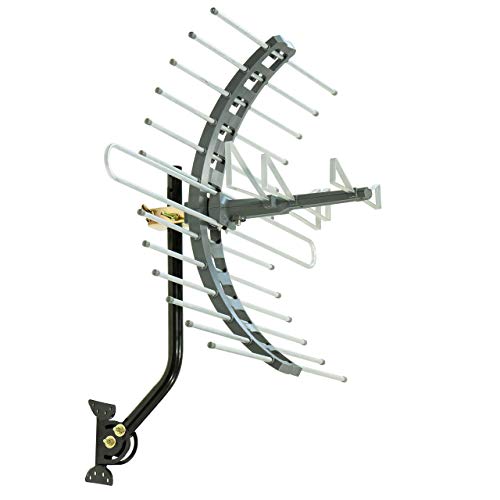
The GE 29884 Pro antenna offers a balanced solution for rural users seeking a compact yet capable design. Its 70-mile range is well-suited for pulling in signals from distant broadcast towers, and its smaller footprint makes it easier to install in an attic if an outdoor mount isn’t preferred. This antenna is built to handle both VHF and UHF channels, ensuring comprehensive channel access.
This model is designed for straightforward installation. It receives power directly through the coaxial cable, which simplifies the setup by eliminating the need for a separate power outlet near the antenna. The durable construction is intended to hold up against various weather conditions when mounted outside, providing a reliable signal source season after season.
RCA Compact Outdoor or Attic Yagi HD TV Antenna

RCA’s Yagi antenna is a classic design known for effective long-range reception, with this model boasting a 75-mile range. It is compatible with the latest broadcast standards, including NexGenTV, 4K, and 8K signals, making it a forward-looking choice. You can access major networks like ABC, CBS, NBC, and FOX without any subscription fees.
The antenna is built with materials that can endure tough outdoor environments, offering peace of mind for permanent exterior installation. Its performance also makes it a strong candidate for attic placement, which can protect it from the most severe weather while still capturing a powerful signal. It serves as an excellent backup during cable or satellite outages, ensuring you stay connected.
Antennas Direct ClearStream 4V Indoor Outdoor TV Antenna

The Antennas Direct ClearStream 4V uses a unique multi-directional design with four patented loops to capture signals from a wide area, which is beneficial if broadcast towers are not all in the same direction from your home. It provides reliable reception from over 70 miles away, bringing in free HD channels without needing an internet connection.
Constructed from premium materials, this antenna is effective whether installed indoors, in an attic, or outdoors in suburban and rural settings. Its compatibility spans from older HDTV standards up to NEXTGEN TV, 4K, and 8K UHD, ensuring it works with both current and future television technology. The included 20-inch mast facilitates secure mounting.
PBD WA-2608 Amplified Outdoor TV Antenna
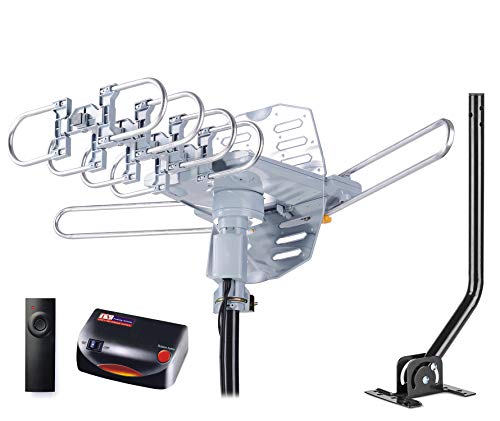
For rural locations with extremely distant towers, the PBD WA-2608 offers an impressive claimed range of up to 150 miles thanks to its built-in high-gain amplifier. Its most notable feature is the 360-degree motorized rotation, which you control with the included wireless remote. This allows you to finely tune the antenna’s direction for the strongest possible signal without leaving your seat.
This antenna includes two outputs, making it possible to connect to multiple televisions. It comes as a complete kit with a mounting pole and 40 feet of RG6 cable, which can simplify the installation process. The weatherproof design ensures it continues to operate reliably through rain, wind, and other outdoor conditions.
Channel Master EXTREMEtenna – Multi-Directional Outdoor HDTV Antenna

The Channel Master EXTREMEtenna employs an 8-bay bowtie design that provides significant reception power, ideal for challenging rural signal environments. It features an 80+ mile range and a wide 180-degree reception span, allowing it to pick up broadcasts from a broad area without requiring physical adjustment. This multi-directional capability is a major advantage for comprehensive channel access.
This antenna delivers uncompressed 1080i HDTV broadcasts, which can offer picture and audio quality that surpasses compressed cable or satellite signals. Its robust construction is made for permanent outdoor installation. By accessing free over-the-air TV, you can enjoy popular channels and shows without any ongoing subscription costs.
Winegard Platinum HD Long Range Outdoor TV Antenna
The Winegard Platinum HD is a respected name in long-range antenna technology, designed specifically for rural and fringe area reception. Its larger, high-gain design is engineered to pull in weak signals from great distances, targeting those who live far from broadcast towers. It captures both VHF and UHF bands to provide a full spectrum of available channels.
Built with durability in mind, this antenna is constructed to perform consistently through various weather conditions. It is an ideal choice for viewers whose primary challenge is sheer distance, as it focuses on maximizing signal gain. For many rural households, this type of powerful, traditional outdoor antenna is the most reliable path to free over-the-air television.
Channel Master EXTREMEtenna Long Range Outdoor TV Antenna
This Channel Master model is another iteration of the powerful EXTREMEtenna series, focusing on long-range performance for rural applications. It utilizes a directional design that concentrates its receiving power in a specific direction, which can be highly effective when aimed correctly at a distant broadcast cluster. This makes it a strong option for maximizing signal strength from one primary direction.
The antenna supports high-definition broadcasts and is built for permanent outdoor mounting. Its design prioritizes pulling in stable signals from faraway stations, reducing pixelation and signal dropouts. For users who have conducted a signal analysis and know the precise direction of their desired towers, this directional antenna can be an excellent solution.
Antennas Direct ClearStream 4V Long Range Outdoor TV Antenna
This listing refers to the outdoor-specific version of the popular ClearStream 4V design. It retains all the benefits of the multi-directional loop technology for capturing signals from a wide 70+ mile area, but is packaged and marketed specifically for outdoor installation. This can be advantageous for achieving the highest possible mounting point for clear line-of-sight to towers.
Its durable construction is rated for all-weather performance, providing a reliable signal year-round. The antenna’s ability to receive next-generation broadcast standards ensures your setup remains compatible as technology advances. For rural users who need wide-angle reception and prefer a dedicated outdoor model, this is a compelling choice.
How to Choose the Best Outdoor TV Antennas for Rural Areas
Living far from the city means your TV antenna isn’t a casual accessory; it’s your primary link to free broadcast television. I’ve learned that picking the wrong one leaves you with a frustrating screen of static. The goal isn’t just to get a signal, but to pull in a clear, reliable picture from miles away. The key factors I always check are range, directionality, build quality, and the type of amplifier.
First, let’s talk range. This is the most advertised number, but you have to be smart about it. Manufacturers often list a maximum “mile” rating under perfect lab conditions. In the real world, hills, trees, and weather cut that down. My rule is to always add a 20-30 mile buffer to the distance shown on a site like FCC DTV Reception Maps. If the nearest towers are 40 miles away, I’m looking at antennas rated for 60+ miles.
Next is directionality. A multi-directional antenna pulls signals from all around, which is great if your broadcast towers are scattered. But if you’re really remote, all your target stations likely come from one general direction. In that case, a directional antenna is your best friend. It focuses its power in one specific direction, giving you a much stronger pull on those distant signals. Some high-end models are even motorized, letting you rotate them from inside your house to fine-tune reception.
Build quality is non-negotiable. You’re mounting this thing outside, where it will face wind, rain, snow, and sun for years. I look for solid, UV-resistant materials, sealed connections, and sturdy mounting hardware. A flimsy antenna won’t survive its first storm. Finally, consider the amplifier. A pre-amplifier (mounted on the antenna mast) boosts the weak signal right at the source before it travels down the long cable to your TV. This can make a huge difference. However, if you’re very close to a tower, an amplifier can actually overload your tuner. It’s a tool for weak, distant signals, not a mandatory add-on.
Frequently Asked Questions
How far can a good outdoor antenna really reach in a rural setting?
In ideal, flat terrain with a clear line of sight, a high-quality, properly installed directional antenna can reliably pull signals from 70-80 miles away. However, “real world” range is heavily affected by obstacles. Dense forests, hills, and even your own roofline can significantly reduce that distance. That’s why using a signal mapping tool and choosing an antenna with a generous range buffer is so important for finding the best outdoor TV antennas for rural areas.
Do I need an amplifier for my outdoor antenna?
Not always. An amplifier (specifically a pre-amplifier) is designed to boost a very weak signal to overcome losses from a long cable run. If you are extremely remote (50+ miles from towers) or have a very long cable from the antenna to your TV, one can be essential. But if you are relatively closer or have a strong signal, an amplifier can overload your TV’s tuner with too much signal, causing pixelation and lost channels. It’s best to try the antenna first without one, then add a pre-amp only if needed.
Can I use a splitter to run one antenna to multiple TVs?
Yes, but every time you split a signal (two-way, four-way split), you weaken the strength going to each TV. In a rural area where the signal is already struggling to reach you, adding a splitter without planning for it can kill your reception. The solution is to use a distribution amplifier. This device actively boosts the signal after the split to ensure each TV gets a strong enough feed. It’s different from a pre-amplifier and is used inside the house.
How important is the mounting height and location?
It’s critical, often more important than the antenna itself. The higher you mount your antenna, the better its chance of clearing local obstacles like trees and buildings. I always aim for the highest, safest point on my property, typically the roof peak. Also, pointing the antenna accurately is vital. Use a compass or a smartphone app to aim it precisely toward the broadcast towers for a directional model. Even a few degrees off can mean the difference between a crystal-clear picture and nothing.
What’s the difference between UHF and VHF, and why does it matter?
These are two different frequency bands used by TV stations. Most digital channels broadcast on UHF, but some (often major networks like ABC, CBS, or PBS) might still be on VHF. Many “flat” or “leaf-style” antennas are primarily designed for UHF. In a rural area, you need an antenna that is rated for both UHF and VHF-Hi reception to ensure you don’t miss key channels. Always check the antenna’s specifications to confirm it receives full spectrum signals.